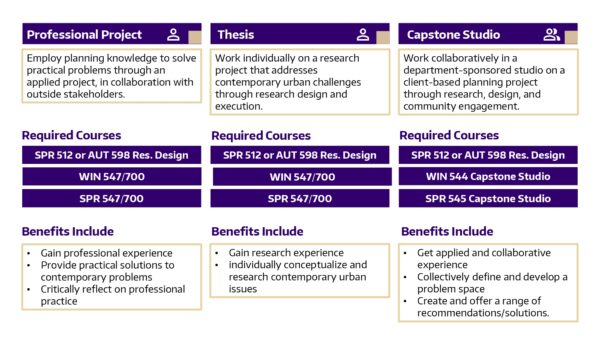
The professional project is a demonstration of your ability to do independent work at a professional level. The project is to be primarily client-oriented, dealing with a particular issue or set of issues, within a specific context. The client, for example, maybe an agency or business within the realm of urban planning, a neighborhood group or non-profit organization, sector of a city, county or other jurisdiction, or be site-specific. The project should bring something new to the situation, demonstrating your ability to synthesize from a broad planning/design context and apply to a specific one.
The project must discuss how the work relates to the larger context of professional urban planning/design in terms of the issues addressed and/or the methods used. This is a fundamental distinction between this professional project, done for 9 academic credits, and a project that may be assigned in a planning/design office. To illustrate the relationship to the larger context, literature reviews, case studies, interviews, critical analyses, and/or references to relevant situations in the professional field may be used.
A professional project, by definition, involves the application of specific planning/design methods and approaches. The project should include an explicit discussion of the approach taken and/or methods employed including alternatives and reasons for approaching the project as selected. In addition, the project should include a summary evaluation including strengths, weaknesses, achievements and lessons learned.
Committee Signature Form for the Master’s Degree
This form is required by the Department. Students obtain the Committee Signature Form by submitting a Master’s Degree Request with the Graduate School:My Grad Login. The MUP Academic Advisor will then be able to access the Committee Signature Form and email a copy of it to the student. Students must obtain signatures from all of their committee members on this form to confirm that their thesis is finished. Students then submit the Committee Signature Form to the MUP Academic Advisor no later than the last day of the quarter in which they graduate.
Signature Page
This form is a required component of the Professional Project. Students create their own signature page using the template in Sample Signature Page for Professional Project. Students must obtain signatures from ALL of their committee members on this signature page. Students must include the signature page in their final professional project.
Initial Topic Development
In summer quarter prior to the final year in the MUP program, students are advised to explore their topic of interest. Students should start reviewing the literature associated with the topic(s). Also, students may start to refine the topics to a series of questions.
URBAN 512 Research Seminar
Students are required to enroll in URBAN 512 Research Seminar. URBAN 512 is designed for MUP students, and guides students through the research process through a series of assignments. Students must be enrolled in or have completed URBAN 512 Research Methods prior to enrolling in URBAN 547 Professional Project. URBAN 598 Research Design for Urban Science may be taken as a substitute for URBAN 512 Research Seminar, although it is designed for PhD students. This course is acceptable for MUP students who have previous research experience, will pursue future doctoral study, or who are pursuing the Environmental Planning specialization (for which the course is a foundational requirement). If you are considering enrolling in URBAN 598 Research Design for Urban Science, talk to your faculty advisor or Prof. Branden Born (instructor of 512) about the appropriate class for you.
Collaborative Professional Project
If the professional project is conducted as a collaborative one, involving other students and/or professionals, the contributions and work of each person must be clearly identifiable within the project. Students pursuing a collaborative professional project with another student should refer to Collaborative Professional Project Requirements.
Each student must assemble a supervisory committee to oversee their work. The Supervisory Committee must consist of at least two graduate faculty members. It is also recommended that a representative of the project’s client(s) be on the committee. It may contain other members as well; the majority of the members must be on the Graduate Faculty of the University of Washington. Please see Supervisory Policy Professional Project regarding the policy and the UW Graduate Faculty page to confirm their status: Graduate Faculty Finder Students should start to think about their committee in summer and autumn quarter of their final year. The student, rather than the Department Chair/faculty/staff, is responsible for assembling their supervisory committee, although the Department Chair/faculty/staff can advise on it.
To register for professional project credits, students must first complete the URBAN 547 Student/Faculty Agreement Form located here: MUP Forms The student obtains the signatures of the committee chair and member(s) on this form, and then submits it to the Graduate Program Advisor by the 3rd day of the quarter in which they plan to register to allow time to process the request before the free add/drop week ends. (Students can register for professional project credits beyond the first week of the quarter, but late fees will apply. Please refer to the UW Academic Calendar for further details.) The Department Chair or MUP Graduate or Program Coordinator/MUP Program Director will then review and sign the form. Once signed, the Graduate Program Advisor will provide the add code to the student who will then register for URBAN 547 professional project credits . Staff do not enroll students in the credits.
Students need only submit the Professional Project Agreement Form once. They do not need to keep submitting it for subsequent quarters. The only exception is if the student changes their committee members. If any committee member is added/dropped to the committee, then the student must submit a new Professional Project Agreement Form signed by all committee members. Students will be issued an add code specific to their committee chair, and may continue to use same the add code to register for Professional Project credits in future quarters without having to resubmit the form. The only exception to this is if the
student changes their committee chair. If so, a new add code specific to the new committee chair will be issued once the student submits the Professional Project Agreement Form again signed by all committee members.
Students are responsible for enrolling in 547 credits each intended quarter with the add code provided. Enrollment is not automatic, and staff do not enroll students in the credits. If a student enrolls in more than 9 credits for their thesis or professional project, only 9 will apply to the degree requirements. Excess thesis or professional project credits will not apply to the degree and cannot fulfill elective credit requirements for the degree.
If a MUP student wants to change their professional project to a thesis, please be aware that previous credits cannot be retroactively changed. Please speak to the GPA for options.
The following roles and responsibilities are general guidelines. They are also not exhaustive, as other criteria may apply.
Committee Chair
The committee chair takes on the lead advising role within the committee. In general, they are responsible for reviewing agreed upon drafts and taking on the bulk of advising. Together, the committee members and student should lay out a schedule that determines how many drafts will be produced, when they will be due, and when comments will be returned.
Committee Member(s)
Committee members generally serve in a supportive role. They may review drafts but may also defer to the committee chair for the bulk of advising regarding the drafts. They may advise on specific content or methods related to the project. They read a final draft of the work.
Client(s)
The client’s role is to establish the scope of work within the project. They are expected to remain in communication with the student during the duration of the student’s project. They are encouraged to give feedback to students about the project, but final say rests with the committee chair and the committee member.
Student
Students are expected to work proactively on their project and manage their own workload and productivity. Students are expected to lead in communicating with their committee. This may include proactively contacting faculty to schedule meetings, following up with faculty about draft reviews, sending reminders for meetings, and so forth.
Students are expected to stick to their agreed upon schedule. They are also responsible for scheduling the defense and coordinating signatures on their final paperwork, and submitting their final paperwork by the deadlines.
It is highly recommended that students follow a schedule as they work on their professional project. A schedule provides structure and helps students stay on target for timely completion. It also establishes expectations for both the student and the supervisory committee, although it is the responsibility of the student to keep to the schedule. The following is provided as a guideline, although each student’s experience may differ.
Summer Quarter (prior to the last year in the MUP program)
- Explore topic of interest. Develop a reading list.
- Consider the faculty who can serve on the supervisory committee. Consider referencing earlier modules regarding who can serve.
Autumn Quarter
- Enroll in URBAN 512 Research Seminar (or URBAN 598 Research Design for Urban Science as a substitute)
- Present a preliminary proposal of your professional project to the proposed committee chair for review:
o Tentative title
o Intent of purpose of the work
o Scope of the work
o An indication of the available literature or other resources to be used (including faculty)
o The methodology or approach to be taken
o An outline of tasks to be accomplished
o A schedule of milestones and committee meetings to be completed within one or two quarters - Confirm both the Chair and Member on the supervisory committee
- Submit Professional Project Agreement Form
Winter Quarter
- Register for Professional Project credits
- Develop a timeline with the committee chair at the beginning of winter quarter.
- Complete the first 3 chapters by the end of winter quarter (if they are not completed, the likelihood of graduating in spring quarter may decrease)
Spring Quarter
- Register for Professional Project credits
- Schedule your defense to occur later in the quarter
- Prepare a powerpoint presentation or poster
See: Checklist for Final Quarter
Summer Quarter
If the professional project is not completed by spring quarter, then the student will need to enroll in a future quarter. Students should consult with their committee members about the possibility of enrolling in summer or autumn quarter to complete the work. Many faculty are not available in the summer, so enrollment in autumn quarter is more typical. International students must consult with International Student Services to determine their eligibility for extending their time to earn the degree.
In the spring quarter of the academic year in which a student completes their MUP program, the Professionals Council sponsors a capstone event to recognize the professional project and thesis work done. All students who plan to graduate in spring or summer quarters are expected to present their capstone work during this event. All students, faculty, and Professionals Council members are invited to attend. Details (date, time, place, presentation template, etc) are provided early in spring quarter from Department staff. Students should plan to make a powerpoint presentation or a poster of their work. These can later be used during the defense.
A final oral examination by the supervisory committee is required. The nature and format of this exam is determined by the chairperson of the committee. The oral examination will primarily concentrate upon the professional project topic, although the committee’s discussion with the student may range more widely in endeavoring to establish the student’s general competence.
The defense is, on average, one hour long. It is recommended that students hold their defense two weeks prior to the last day of the quarter. The Gould 410 conference room is available for students to use. The defense may be held virtually or in person, depending on the committee’s preference and availability. ALL members of the committee must be present in some form during the defense. It is the student’s responsibility to schedule the defense and coordinate the schedules of their committee members. Students are advised to confirm their defense date with their committee months ahead of time to avoid scheduling challenges.
Be prepared to explain: (a) What you did, (b) Why you did it, (c) How you did it, (d) What you found, and (e) What the results mean. The defense may include visuals in the form of a PowerPoint presentation, poster, etc. Typically, they should include (a) An overview or outline of your presentation, (b) Introduction (including research question, rationale and hypothesis, if any, and definition of key constructs), (b) Method (including design, methodology, etc.), (c) Results (including tables or figures summarizing your findings) and (d) Discussion (including reasons for new or unexpected findings, contributions and
limitations, and practical implications). It is expected that the student, chairperson, and all members of the committee be present at the defense. The client must attend the defense if he/she is a formal member of the committee (i.e. their name and signature is included on your URBAN 547 Student Agreement Form for Professional Project); attendance is optional if the client is not a formal member of the committee. You may invite others to the defense in circumstances that warrant it. Please check with your committee chair for their preference.
Please bring the following to your defense:
- Copy of your final professional project
- Committee Signature Form
- Signature page Sample Signature Page for Professional Project
The Committee Signature Form and signature page may be signed at the defense if your committee agrees that you have successfully completed the project, or signed afterwards if you need to incorporate edits into your final draft. Be careful to coordinate signatures with your committee members’ respective schedules, as all signatures are required and no committee member may sign off on a professional project without having read it in its final form.
Please see the Checklist for Defense Professional Project
MUP students must upload their professional project as one digital file by 11:59pm on the last day of the quarter in a shared drive, for which the Graduate Program Advisor will provide the link.
The format should be determined by the nature of the project and its client, with the approval of the Supervisory Committee chair. The report should be of professional quality. Graphics and tables should be integrated with text insofar as possible. Black and white or color is acceptable. All questions regarding format should be referred to the chair of your Supervisory Committee before the final preparation and presentation of the professional project.
The following must be included in your Professional Project:
- Signature Page Sample Signature Page for Professional Project
- Quote Slip Sample quote slip for professional project
- Title Page Sample Title Page Professional Project
- Body of the professional project
- Accompanying tables, graphs, etc
On or before the last day of the quarter, upload the electronic file of your Professional Project via google form; the Graduate Program Advisor will provide the link each quarter.
Your Professional Project will be available to the public
A Master of Urban Planning thesis is an investigation that demonstrates a student’s ability to conceive, conduct and report the results of a substantial individual study in the field of urban design and planning. The essential value of the thesis is in the process of doing it rather than in the product that results, though some theses do also make valuable additions to the literature of the profession. The educational values are, first, the opportunity to pursue some area of interest to a level of depth, completeness and conclusiveness that is not possible in other courses; and secondly, to work on an individual basis with faculty who are informed and interested in the subject. The topic of the thesis may be broad or narrow, academic or applied, synoptic or analytical, empirical or theoretical, and anywhere within the wide range of urban planning concerns. It is limited only by the need to focus on an area relevant to urban planning, by faculty interests, and by the resources of the University. Because urban planning is a broad field, the range of appropriate topics is very broad. Typically, the thesis topic relates to the student’s area of specialization. Urban Design Certificate students, for example, are required to select an urban design-related thesis topic. Each student should examine carefully his or her choice of a topic, proposing work that can be accomplished within one or two quarters. Each person must also find his or her own answers to questions such as: “What can I gain from this study?”, “What may others gain?”, and “Will I be able to utilize my skills and abilities in a way that will be academically enriching for me, my committee, and the University?” These and related questions require answers at the proposal stage.
There are two main required administrative forms:
Master’s Supervisory Committee Approval Form
This form is required by the Graduate School. Students obtain the form from the Graduate School’s webpage:
Thesis/Dissertation Students must obtain signatures from all of their committee members on this form to confirm that their thesis is finished. Students must then upload it to the UW ETD Administrator Site along with the finalized electronic version of their thesis (see link above) no later than the last day of the quarter in which they graduate.
Committee Signature Form for the Master’s Degree
This form is required by the Department. Students obtain the Committee Signature Form by submitting a Master’s Degree Request with the Graduate School: My Grad Login. The MUP Academic Advisor will then be able to access the Committee Signature Form and email a copy of it to the student. Students must obtain signatures from all of their committee members on this form to confirm that their thesis is finished. Students then submit the Committee Signature Form to the MUP Academic Advisor no later than the last day of the quarter in which they graduate.
Initial Topic Development
In summer quarter prior to the final year in the MUP program, students are advised to explore their topic of interest. Students should start reviewing the literature associated with the topic(s). Also, students may start to refine the topics to a series of questions.
URBAN 512 Research Seminar Students are required to enroll in URBAN 512 Research Seminar in autumn quarter of their final year. URBAN 512 is designed for MUP students, and guides students through the research process through a series of assignments, which students can use to develop their thesis or professional project if their topic is confirmed. Prior to enrolling in URBAN 700 thesis, students must be enrolled in or have completed URBAN 512 Research Methods.
URBAN 598 Research Design for Urban Science may be taken as a substitute for URBAN 512 Research Seminar, although it is designed for PhD students. This course is acceptable for MUP students who have previous research experience, will pursue future doctoral study, or who are pursuing the Environmental Planning specialization (for which the course is a foundational requirement). If you are considering enrolling in URBAN 598 Research Design for Urban Science, talk to your faculty advisor or Prof. Branden Born (instructor of 512) about the appropriate class for you.
Students must register for and complete a minimum of 9 thesis credits in order to graduate from the MUP program. Students may register for more than 9 credits if needed, but only 9 will count towards the degree. Any excess thesis credits will not count towards elective credit totals. Students typically enroll in thesis credit in winter and spring quarter of their final year in the MUP program. The 9 credits are usually divided between quarters. For example, a student may register for 4 thesis credits in Winter quarter, and 5 thesis credits in Spring quarter, for a total of 9 credits. The general rule of thumb is that students should enroll in credits commensurate with the amount of work they put into the thesis. This can be roughly determined by considering the hours of work that one would do for another graduate-level course of the same credits. Students must be registered for a minimum of 2 credits during the quarter in which they graduate. Students pursuing a concurrent degree must follow the other program’s guidelines in addition to the MUP guidelines, as guidelines may differ across programs.
Informal concurrent students should be aware that enrollment in thesis credits is not the same as enrolling in a class; it is independent work that the student executes on an agreed-upon schedule with the consultation of the supervisory committee.
To register for thesis credits, students must first complete the URBAN 700 Student/Faculty Agreement Form located on the MUP Forms webpage: MUP Forms
The student obtains the signatures of the committee chair and member(s) on this form, and then submits it to the Graduate Program Advisor by the 3rd day of the quarter in which they plan to register to allow time to process the request before the free add/drop week ends. (Students can register for thesis credits beyond the first week of the quarter, but late fees will apply. Please refer to the UW Academic Calendar for further details: UW Academic Calendar) The Department Chair or Graduate Program Coordinator/MUP Program Director will then review and sign the form. Once signed, the Graduate Program Advisor will email the add code to the student who will then register for URBAN 700 thesis credits; staff do not enroll students in the credits.
Students need only submit the Thesis Agreement Form once. They do not need to keep submitting it for subsequent quarters. The only exception is if the student changes their committee members. If any committee member is added/dropped to the committee, then the student must submit a new Thesis Agreement Form signed by all committee members.
Students will be issued an add code specific to their committee chair, and may continue to use the same add code to register for thesis credits in subsequent quarters. The only exception to this is if the student changes their committee chair. If so, they will need to submit a new Thesis Agreement Form signed by all committee members, and receive a new add code from the GPA.
Students pursuing a concurrent degree must follow the other program’s guidelines in addition to the MUP guidelines, as they may differ.
If a student enrolls in more than 9 credits for their thesis or professional project, only 9 will apply to the degree requirements. Excess thesis or professional project credits will not apply to the degree and cannot fulfill elective credit requirements for the degree.
If a MUP student decides to change their thesis to a professional project or vice versa, please be aware that it is not possible to retroactively change the course designation on the transcript for previous quarters. Please speak to the GPA for options.
Committee Chair
The committee chair takes on the lead advising role within the committee. In general, they are responsible for reviewing agreed upon drafts and taking on the bulk of advising. Together, the committee members and students should lay out a schedule that determines how many drafts will be produced, when they will be due, and when comments will be returned.
Committee Member(s)
Committee members generally serve in a supportive role. They may review drafts but may also defer to the committee chair for the bulk of advising regarding the drafts. They may advise on specific content or methods related to the thesis. They read a final draft of the work.
Student
Students are expected to work proactively on their thesis and manage their own workload and productivity. Students are expected to lead in communicating with their committee. This may include proactively contacting faculty to schedule meetings, following up with faculty about draft reviews, sending reminders for meetings, and so forth.
Students are expected to stick to their agreed upon schedule. They are also responsible for scheduling the defense and coordinating signatures on their final paperwork, and submitting their final paperwork by the deadlines.
Each student must assemble a supervisory committee to oversee their work. The supervisory committee must consist of at least two graduate faculty members. It may contain other members as well; the majority of the members must be on the Graduate Faculty of the University of Washington. Please see Thesis Supervisory Policy regarding the policy and the UW Graduate Faculty page to confirm their status: Graduate Faculty Finder Students should start to think about their committee in summer and autumn quarter of their final year. The student, rather than the Department Chair/faculty/staff, is responsible for assembling their supervisory committee, although the Department Chair/faculty/staff can advise on it.
It is highly recommended that students follow a schedule as they work on their thesis. A schedule provides structure and helps students stay on target for timely completion. It also establishes expectations for both the student and the supervisory committee, although it is the responsibility of the student to keep to the schedule. The following is provided as a guideline, although each student’s experience may differ.
Summer Quarter (prior to the last year in the MUP program)
- Explore topic of Develop a reading list.
- Consider the faculty who can serve on the supervisory Thesis Supervisory Policy and the Graduate Faculty Locator Graduate Faculty Finder regarding who can serve.
Autumn Quarter
- Enroll in URBAN 512 Research Seminar (URBAN 598 Research Design for Urban Science may be taken as a substitute)
- Present a preliminary proposal of their thesis to their proposed committee chair for review:
- Tentative title
- Intent of purpose of the work
- Scope of the work
- An indication of the available literature or other resources to be used (including faculty)
- The methodology or approach to be taken
- An outline of tasks to be accomplished
- A schedule of milestones and committee meetings to be completed within one or two quarters
- Confirm both the Chair and Member on the supervisory committee
- Submit Thesis Agreement Form
Winter Quarter
- Register for Thesis credits
- Develop a timeline with the committee chair at the beginning of winter
- Complete the first 3 chapters by the end of winter quarter (if they are not completed, the likelihood of graduating in spring quarter may decrease)
Spring Quarter
- Register for Thesis credits
- Schedule the defense to occur later in the quarter
- Prepare a PowerPoint presentation or poster
A final oral examination by the supervisory committee is required. The nature and format of this exam is determined by the chairperson of the committee. The oral examination will primarily concentrate upon the thesis topic, although the committee’s discussion with the student may range more widely in endeavoring to establish the student’s general competence.
The defense is, on average, one hour long. It is recommended that students hold their defense two weeks prior to the last day of the quarter. The Gould 410 conference room is available for students to use. The defense may be held virtually or in person, depending on the committee’s preference and availability. ALL members of the committee must be present in some form during the defense. It is the student’s responsibility to schedule the defense and coordinate the schedules of their committee members. Students are advised to confirm their defense date with their committee months ahead of time to avoid scheduling challenges.
Be prepared to explain: (a) What you did, (b) Why you did it, (c) How you did it, (d) What you found, and (e) What the results mean. The defense may include visuals in the form of a PowerPoint presentation, poster, etc. Typically, they should include (a) An overview or outline of your presentation, (b) Introduction (including research question, rationale and hypothesis, if any, and definition of key constructs), (b) Method (including design, methodology, etc.), (c) Results (including tables or figures summarizing your findings) and (d) Discussion (including reasons for new or unexpected findings, contributions and limitations, and practical implications).
It is expected that the student, chairperson, and all members of the committee be present at the defense. Students may invite others to the defense in circumstances that warrant it. Please check with your committee chair for their preference.
Please bring the following to your defense:
- Copy of your final thesis (digital or print)
- Committee Signature Form
- Supervisory Committee Approval Form
The Committee Signature Form and supervisory committee approval form may be signed at the defense if your committee agrees that you have successfully completed the thesis, or signed afterwards if you need to incorporate edits into your final draft. Be careful to coordinate signatures with your committee members’ respective schedules, as all signatures are required and no committee member may sign off on a thesis without having read it in its final form.
Please see the Checklist for Defense
In the spring quarter of the academic year in which a student completes their MUP program, the Professionals Council sponsors a capstone celebration event to recognize the professional project and thesis work done. All students who plan to graduate in spring or summer quarters are expected to present their capstone work during this event. All students, faculty, and Professionals Council members are invited to attend. Details (date, time, place, presentation template, etc) are provided early in spring quarter from Department staff. Students should plan to make a PowerPoint presentation or a poster of their work. These can later be used during the defense.
All MUP students pursuing the capstone studio must take it in two sequenced quarters, 3 credits in winter and 6 credits in spring, for a minimum of 9 credits.
Students pursuing the capstone studio are required to enroll in URBAN512 Research Seminar. URBAN 512 is a research methods class designed for MUP students specifically, and guides students through the research process through a series of assignments. Prior to enrolling in capstone studio, students must have completed URBAN 512 Research Methods
URBAN598 Research Design for Urban Science may be taken as a substitute for URBAN512 Research Seminar, although it is designed for PhD students. This course is acceptable for MUP students who have previous research experience, will pursue future doctoral study, or who are pursuing the Environmental Planning specialization (for which the course is a foundational requirement). If you are considering enrolling in URBAN598 Research Design for Urban Science, talk to your faculty advisor, Prof. Alberti (instructor of URBAN 598 Research Design for Urban Science) or Prof. Branden Born (instructor of 512) about the appropriate class for you.
Students pursuing the capstone studio are required to enroll in two sequential quarters in Winter (3 credits) and Spring (6 credits) of their final year. For example, students are not allowed to complete the winter course in one year and the spring course in another year. Students pursuing the capstone studio are not eligible for the Graduate Registration Waiver (two-week extension on the graduation deadline).
The MUP capstone studio can satisfy the Urban Design Certificate/Specialization thesis requirement, if the capstone studio has an urban design component as approved by the urban design faculty. The MUP capstone studio cannot serve as the Urban Design Certificate advanced studio requirement. The capstone studio is complete once the student completes two sequenced quarters in a year and receives a passing grade of CR for each class. If a student is unable to complete the capstone studio sequence in one year they will need to enroll in two sequenced quarters of the capstone studio in a future year, or they can also choose to switch to a thesis or professional project in the future for a total of 9 credits. Capstone studio credits cannot apply to thesis and professional project credits, and vice versa.
Capstone studio students do not have the option to use the Graduate Registration Waiver (two week extension).